


2026
Water: The Essence of Life
A Journey Through the Science, Mystery, and Consciousness of the Universe's Most Extraordinary Substance
Water: The Essence of Life is an exploration of the most familiar—and perhaps the most mysterious—substance in existence. Though it surrounds us, flows through us, and sustains every known form of life, water remains one of the least understood phenomena in nature. This book invites readers on an extraordinary journey that begins at the birth of the universe and culminates in the depths of human consciousness.
Tracing hydrogen to the first moments after the Big Bang and oxygen to the fiery hearts of ancient stars, the book reveals how water emerged from cosmic evolution and became the foundation of planets, oceans, ecosystems, and living cells. Along the way, it explores the remarkable chemistry and physics that make water unique, from its anomalous molecular properties and hydrogen-bonding networks to emerging theories of structured water, coherence domains, and biological organization.

Karma Revealed
Karma Revealed is a profound exploration of the invisible architecture that shapes human experience. Drawing from the Vedas, Upanishads, the Bhagavad Gītā, and the Yoga Sūtras, the book restores karma to its original meaning—not as a system of cosmic reward and punishment, but as the precise law by which consciousness becomes form, habit becomes destiny, and choice becomes evolution.
The work begins by establishing karma as an interplay between discrete action (karma) and lived conduct (ācāra), showing how repeated patterns—rather than isolated deeds—shape the character of a life. It then traces the metaphysical chain described in the Taittirīya and Maitrī Upanishads: desire → will → action → destiny, revealing that the root of all becoming lies not in external forces but in the desires we serve, consciously or unconsciously.


2025

2026

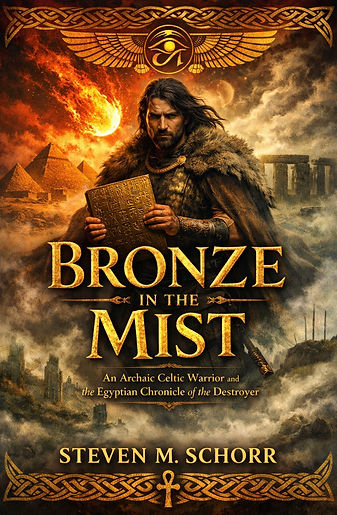
Bronze in the Mist
Bronze in the Mist is a visionary historical novel that binds ancient Egypt and Celtic Britain into a single lineage of warning. The story begins when Bran, a hardened Celtic warrior, raids a coastal monastery and discovers not treasure but a sealed bronze reliquary—plates engraved with a record older than Rome. These inscriptions, known as the Bronzebook, preserve an Egyptian chronicle of a recurring celestial catastrophe called the Destroyer: wrong dawns, poisoned waters, social fracture, and the moral unraveling of civilizations.
Through embedded “found texts,” the narrative moves to Egypt, where temple stargazers record environmental upheaval and recognize a pattern of recurrence rather than divine whim. Cataclysm is not myth but memory—etched into metal so it can survive fire and political erasure. Back in Britain, Bran becomes an unlikely custodian. As abbeys burn and authorities suppress dangerous knowledge, preservation itself becomes warfare. He forges a hidden lineage dedicated to one law: continuity of warning. What survives fire must also survive kings.

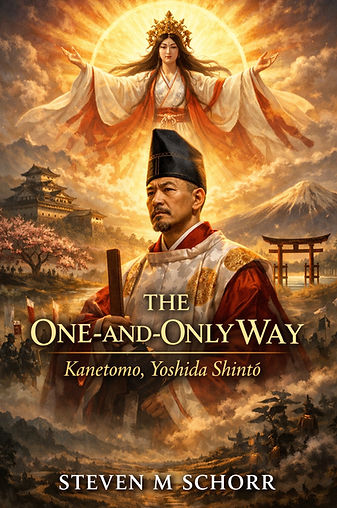
The One-and-Only Way
The One and Only Way is a scholarly study of Yoshida Kanetomo (1435–1511) and the late-medieval remaking of Shintō into a comprehensive framework of truth, ritual authority, and institutional governance. Kanetomo’s innovation begins with a naming act: he styles his tradition Yuiitsu (“only-one”) Shintō, also called Sōgen / Genpon Sōgen (“original / fundamental and original”) Shintō, asserting primacy beneath the era’s plural religious ecology. At the heart of his metaphysics is a triadic ontology—kami, rei, and shin—described as a unified existence “prior to heaven and earth,” in which the “myriads of kami” are ultimately one. Shintō is thereby reframed as a Way of Truth (reisei): not merely devotion to kami, but a disciplined method for discerning the “unadulterated, true kami” within a spiritually mixed world.

2026


2025

The Standing Stone
Dora Donagal grows up on the wild Oregon coast, half-feral and more at home in the storm-lashed forest than at school or on a screen. Her family history is tangled with logging and the sea; only her Irish grandmother Maeve still speaks of “thin places” where the world wears through. During a Pacific storm Dora is drawn off the trail and discovers a moss-covered standing stone hidden in the back hill, carved with faint spirals and humming with an uncanny warmth.
Touching the stone on Samhain flings Dora through a doorway in time and space into an ancient Druid grove in the Celtic lands. There she meets Brannagh, Cian, Eira and Talies, who recognize her as a “door-walker” between worlds. Over many journeys she is initiated into the threefold path of Bard, Ovate, and Druid: learning word-magic and song, reading signs in weather and dreams, and studying an ethic where land, people, and spirit are one web of reciprocity.
A great Council of Stones reveals that her Oregon monolith is part of a global web of “memory stones” dimming as humans treat land as resource, not relative. Entrusted with a quiet seal in her heart, Dora returns home.
Back in the rain and fog, she begins small: morning greetings to ditch and tree, story nights, forest walks. When an old-growth cut threatens the hill, her devotion deepens into grounded activism, and the Standing Stone slowly becomes a shared, living temple—a bridge of song between ages, lands, and hearts.